Key Takeaways
Vertical boat lifts deliver the widest vertical adjustment range—ideal for lakes and rivers with fluctuating water levels.
Hydraulic lifts provide smooth, powerful lifting but less flexibility in shallow or variable-depth water.
Vertical hydraulic lifts perform well, while hydraulic cantilever lifts are not ideal for changing water levels.
Choosing the right lift reduces maintenance and protects your boat year-round.
ShoreMaster’s vertical lifts are engineered for reliability and long-term performance across conditions.
How Water Level Fluctuations Impact Lift Performance
A boat lift’s operational range is defined by its ability to clear the water’s surface to securely store vessels while lowering enough for a safe launch. If water levels drop below a lift’s minimum operation depth, the cradle cannot lower far enough to float the vessel on or off the bunks (Zogalis, Maratta, 2025).
To put this in perspective, a boat stored on a cantilever lift (which typically has a more limited vertical travel) during high-water events may not sit high enough above the waterline to prevent the boat from floating off the cradle should water levels rise past its maximum lift height.
Fluctuating water levels can also cause the lakebed to soften or shift, causing a lift’s footpads to settle unevenly (Donohue, Molinos, 2009). A lift that isn’t level puts disproportionate stress on cables, pulleys, and hydraulic cylinders. For vertical lifts, being off-level by as little as six inches can lead to premature cable failure or jammed pulleys.
Vertical Boat Lifts: Designed for Versatility
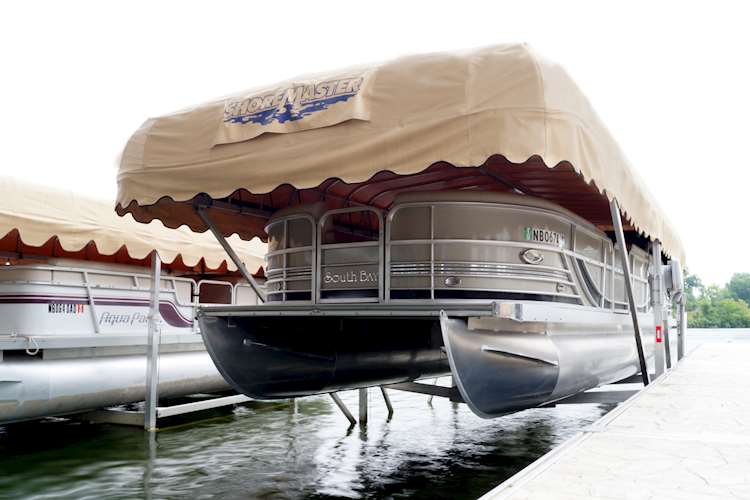
ShoreMaster Vertical Boat Lifts are widely regarded as some of the most versatile in-water storage solutions due to their exceptional lift travel (a standard of 66” and up to 80” depending on the configuration). This allows them to provide ample clearance during high-water events while still lowering enough for safe loading and launching during seasonal drawdowns.
Their vertical design distributes weight straight down onto the footpads, enabling them to perform reliably on soft, muddy, or uneven lake bottoms. Moreover, ShoreMaster’s H-frame design allows waves, wakes, and current to pass through the lift rather than pushing against it. This open structure reduces lateral stress on the frame, helping maintain stability in rough water or busy boating areas.
Add the option to upgrade to motorized control, customizable bunks, and seamless integration with ShoreMaster’s Infinity Waterfront System (which includes docks, accessories, and canopies), and you have an adaptable watercraft storage solution that delivers reliable performance no matter how unpredictable your shoreline becomes.
Hydraulic Boat Lifts: Power Meets Precision
Hydraulic boat lifts use pressurized fluid within sealed cylinders to raise and lower a vessel, eliminating the need for traditional manual winches, cables, and pulleys. However, other brands still use hidden pulley-and-cable systems to transfer motion. ShoreMaster’s TruLift series does not.
This allows our to lift 100% of their rated capacity (6,000 to 12,500 lbs), using a pressure-balanced, bi-rotational pump to lift vessels at a steady speed of ~1 inch per second.
Their lay-flat cantilever designs allow the entire frame to fold down when lowered, with the rack sitting nearly flush with the base. This allows a boat to float on and off the lift in as little as 16 to 20 inches of water (plus the boat’s draft), making hydraulic cantilever lifts an excellent choice where depth is limited, but water levels remain relatively consistent.
However, because cantilever hydraulic lifts raise the boat in a forward, arcing motion, they require firm terrain to prevent the lift from shifting during operation. The arcing motion also limits total vertical travel (typically capped between 48 and 60 inches), making them less ideal for areas where the water level might drop 4 feet in a single season.
Side-by-Side Lift Comparison Chart
Feature | Vertical boat Lift | Hydraulic Boat Lift |
Lifting Capacity | 3,000 lbs to 7,000 lbs | 6,000 lbs to 12,000 lbs |
Minimum Depth | At 36" + boat draft | At least 16" to 26" + boat draft |
Vertical Travel (Range) | 66" to 80" | 48" to 60" |
Maintenance | Regular cable/pulley inspection and seasonal lubrication. | Periodic check of seals, battery, and fluid levels. |
Ideal Use Case | Fluctuating water, rough lakes, and lighter to mid-weight vessels. | Moderately shallow to deeper water (around 3-10 feet), pontoons, wake boats, and cruisers provide premium convenience and high-frequency use. |
Why ShoreMaster Recommends Vertical Lifts for Variable Water Levels
When water levels rise and fall, adaptability becomes a boat lift’s most valuable feature. Vertical lifts deliver the widest range of travel, ensuring your boat can be safely launched during seasonal drawdowns and securely stored above the waterline during high‑water events.
Unlike cantilever designs, which are limited by their arcing motion, vertical lifts move straight up and down, providing maximum clearance and stability even when the lakebed shifts or softens.
ShoreMaster Vertical Lifts combine functional versatility with dime-welded aluminum construction for superior rigidity, an H-frame design that resists lateral stress, and footpads to help distribute weight evenly. The result is a system that adapts to changing conditions without compromising safety or performance.
If you want the best of both worlds, ask about the ShoreMaster Vertical Hydraulic. It combines the superior lift range of a vertical frame with the cable-free, push-button power of a hydraulic system. Enter your zip code in the dealer locator tool below to get a list of authorized ShoreMaster dealers near you.
FAQs
Which type of lift works best in changing water levels?
Vertical boat lifts are the most reliable choice for fluctuating water levels because they offer the widest range of vertical travel. This allows them to safely launch during seasonal drawdowns and keep boats secure above the waterline during high‑water events. Their straight‑up‑and‑down motion also maintains stability on uneven or soft lakebeds.
Can hydraulic lifts handle shallow water?
Yes. ShoreMaster Hydraulic Lifts can handle shallow water, often requiring as little as 16-20 inches of depth (plus boat draft). Their lay‑flat design makes loading and unloading easy in limited depth, though they perform best in areas where water levels remain relatively consistent.
What’s the difference between vertical and cantilever lifts?
Vertical lifts move straight up and down, providing maximum clearance and adaptability in variable water levels. Cantilever lifts raise boats in an arcing motion, which requires firm terrain and limits vertical travel, making them better suited for shallow but stable water conditions.
Can a hydraulic lift be upgraded for fluctuating conditions?
No. Their core design limits their vertical travel. For shorelines that experience significant water level fluctuations, a vertical lift (or vertical hydraulic lift) is generally the more optimal long-term solution.
What’s the typical maintenance for a vertical lift?
Vertical lifts require routine checks of cables, pulleys, and footpads to ensure the system operates smoothly and stays level. Additionally, seasonal inspections for wear, lubrication of moving parts, and adjustments to account for shifting lakebeds help optimize the lift’s lifespan while mitigating costly repairs.
References:
Ian Donohue, Jorge Garcia Molinos, School of Natural Sciences, Department of Zoology, Trinity College Dublin (March 23, 2009). Impacts of increased sediment loads on the ecology of lakes, https://www.jlakes.org/ch/web/impacts-increased-sediment-loads-ecology-lakes-BS2009.pdf
Elizabeth Zogalis, Alessia Maratta (October 15, 2025). Low water levels on St. Lawrence River causing problems for marinas, shipping industry, https://globalnews.ca/news/11479996/low-water-levels-st-lawrence-river-problems-marinas-shipping-industry/


